
Medial and Lateral Epicondylitis
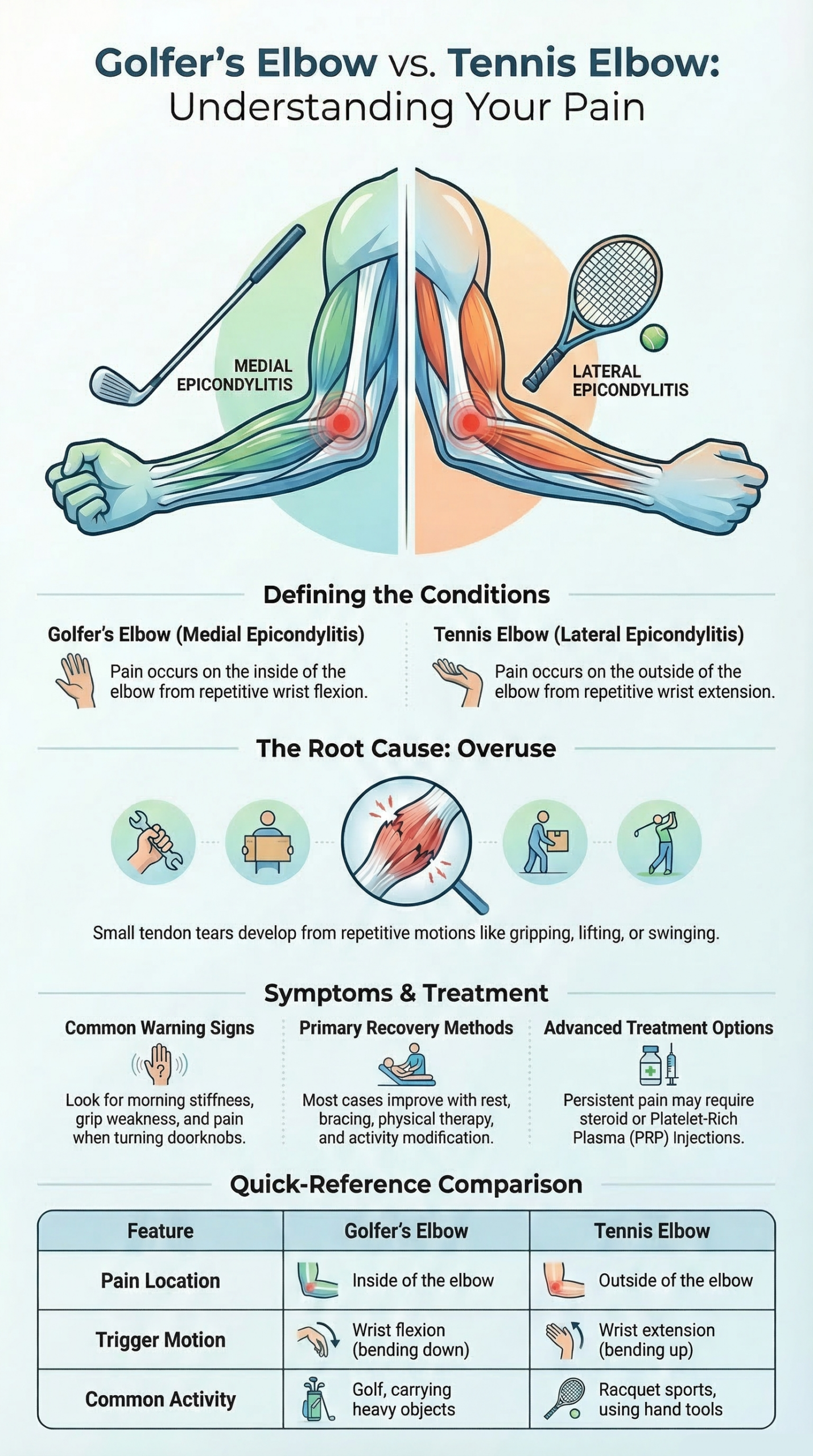
Medial and lateral epicondylitis are conditions caused by overuse of the muscles and tendons in the forearm. Medial epicondylitis, often called golfer’s elbow, affects the tendons on the inside of the elbow. Lateral epicondylitis, known as tennis elbow, affects the tendons on the outside of the elbow. Both conditions can cause significant pain and limit a person’s ability to perform everyday activities like lifting, gripping, or carrying objects related to musculoskeletal pain.
Evaluating Your Condition
WHAT CAUSES GOLFER’S ELBOW AND TENNIS ELBOW?
Golfer’s elbow happens when small tears develop where the forearm flexor tendons attach to the inside of the elbow. These tears are often caused by activities that involve repetitive bending of the wrist or fingers. Common examples include swinging a golf club, carrying heavy objects, or performing manual labor that requires frequent wrist flexion.
Tennis elbow is caused by overuse of the extensor tendons that attach to the outside of the elbow. Repetitive wrist extension or twisting motions can strain these tendons. This is often seen in people who play racquet sports like tennis or work in professions that involve frequent lifting, gripping, or using tools that require wrist movement. These repetitive strain injuries are commonly associated with conditions like joint pain.
WHAT ARE THE SYMPTOMS OF GOLFER’S ELBOW AND TENNIS ELBOW?
The symptoms of golfer’s elbow and tennis elbow often develop gradually and can vary in intensity. Individuals with golfer’s elbow typically experience pain and tenderness along the inside of the elbow, while those with tennis elbow notice similar discomfort on the outside of the elbow. The pain may start off mild but can become more severe with continued activity.
Many people also report stiffness in the elbow, especially first thing in the morning, making it difficult to fully straighten or bend the arm. Weakness in the wrist or hand is another common symptom, leading to challenges when trying to grip objects firmly. Activities such as lifting a cup, turning a doorknob, or shaking hands may trigger or worsen the pain. The discomfort tends to increase with activities that involve wrist movement or gripping and often improves with rest. In some cases, the pain can radiate down the forearm, making even simple daily tasks uncomfortable. In some cases, symptoms may overlap with neuropathy, especially when tingling or weakness is present.
DIAGNOSING GOLFER’S ELBOW AND TENNIS ELBOW
To find out what’s causing your pain, your pain management doctor will start by reviewing your symptoms and asking about your daily activities. They’ll gently check your elbow, wrist, and forearm for sore spots, swelling, or stiffness. You may also be asked to squeeze or lift something so they can check your grip strength.
If needed, your doctor might order an X-ray to rule out other causes like arthritis or conditions such as degenerative joint disease. Sometimes, an MRI can help show how much the tendons are irritated or damaged.
WHEN SHOULD I CONSIDER GETTING TREATMENT?
If your elbow pain hasn’t improved after a few weeks of resting, using ice, or taking over-the-counter pain relievers, it may be time to see a pain management doctor. You should also consider treatment if the pain makes it hard to do everyday things, like lifting groceries, turning a doorknob, writing, or using tools at work.
Getting help early can prevent the problem from becoming long-term, and treatment options like medication management can help you get back to doing the things you enjoy.
Common Questions About Golfer’s Elbow and Tennis Elbow
Will this go away on its own?
Sometimes mild cases can improve with rest, ice, and activity changes. But if the pain sticks around or keeps coming back, it’s a good idea to talk to a specialist to prevent it from becoming a long-term problem.
Can I keep working or exercising?
It depends on what’s causing the pain. Some people can keep working with small changes, like using a brace or avoiding certain motions. Your care team can guide you on what’s safe and what to avoid while you heal.
Do I need an injection?
Not always. Many people feel better with rest, therapy, and bracing. If those don’t help, targeted injections or advanced therapies may be recommended to reduce inflammation and speed up recovery.
How long does recovery take?
Everyone heals at a different pace, but many people start to feel better within a few weeks of starting treatment. Full recovery can take several weeks or even a few months, especially if the tendons are badly irritated.
What happens if I don’t treat it?
Without treatment, the pain can become chronic and make it harder to do daily activities. Getting care early gives you a better chance of healing and avoiding long-term issues.
Common Treatments Available for Golfer’s Elbow and Tennis Elbow
- NSAIDs
- Injections to the Medial Epicondyle
- Physical Therapy


